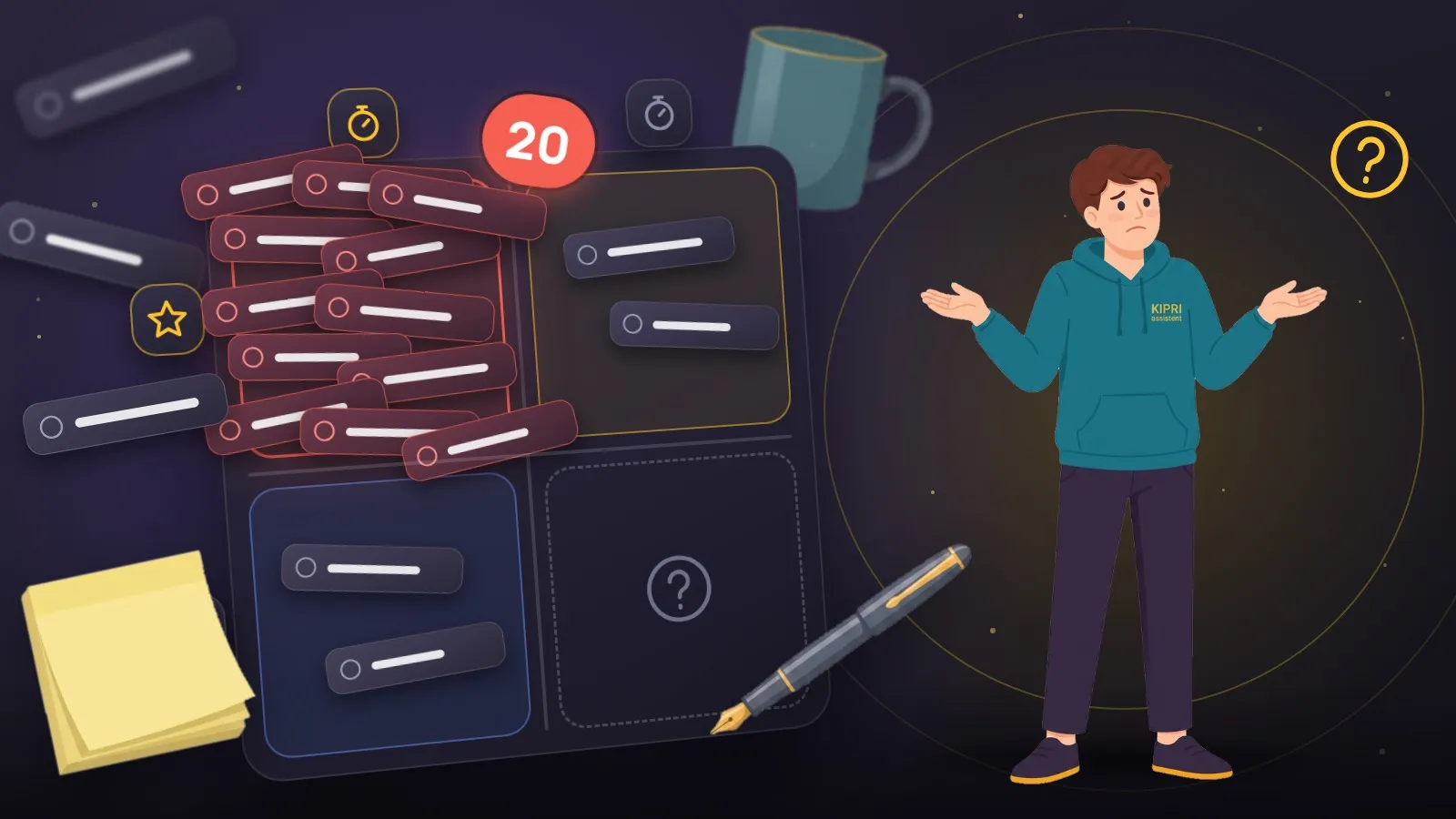
Everyone knows the matrix: a square cut into four, urgent along one axis, important along the other. Everyone knows it, draws it once, and never comes back. Laziness is not the reason.
Start with where it came from, because that explains the problem
Eisenhower never drew a matrix. In a 1954 speech he quoted a line he attributed to a former university president: I have two kinds of problems, the urgent and the important; the urgent are not important, and the important are never urgent.
That is an observation, not a method. Stephen Covey turned it into a method in 1989 by laying the thought out on a grid. The grid was vivid, and its vividness is what killed it: people take the shape and lose the original idea, which was about something else.
The four cells
Urgent and important. On fire. Do it now.
Important, not urgent. Health, relationships, learning, everything that pays off in six months. For Covey this is the only cell that changes a life.
Urgent, not important. Other people’s requests, calls, emails marked urgent by people for whom everything is urgent.
Neither. Tidying your browser tabs.
Where it breaks
Take your actual list for this week. Not the tidy example from the book, the one with twenty-three items on it. Now sort them.
Urgency and importance are not properties of a task. The same item is not urgent on Tuesday and is on fire by Thursday evening. Which means the cell has to be reassigned daily, and the matrix becomes work that exists to maintain itself.
Everything slides into the first quadrant. Ask yourself whether a task is important and you will answer “well, yes” to nearly all of them. You would not have written it down otherwise. The result is twenty items in “urgent and important” and three across the other three cells.
The matrix says nothing about order. Inside that first quadrant you still have ten things, and “what do I start with” is exactly where you were. The matrix answers “what can I drop”, which is rarely the question that hurts.
The fourth quadrant is empty. Nobody writes down things that are neither important nor urgent. So a quarter of the diagram sits idle, and with it half of the point.
What works instead of sorting
One question per item: what happens if I do not do this week.
The answers come in three flavours. Consequences for other people or for money, so it goes first. Unpleasant but survivable, so it goes in the middle. Nothing happens at all, and here is where the fourth quadrant finally earns its keep: that item can be deleted rather than postponed for the eighth time.
The question works better because it is about the future rather than about a label. “Important” is a judgement, and judgements are easy to talk yourself into. “What happens if I skip it” is a prediction, and lying to yourself in a prediction is noticeably harder.
How this fits on a phone
You do not need four quadrants on a screen. Two things are enough.
First, a mark on the items that carry consequences. Tasks in KIPRI have colour statuses for this, and two of them do the job: urgent and ordinary. Do not add a third “medium” level; it becomes the bucket for everything you cannot be bothered to judge.
Second, a tag or a note about what the task is for. That is Covey’s second quadrant, expressed as a connection rather than a cell. “See the doctor” reads like a burden on a list. “See the doctor so my back does not go before the holiday” reads like an investment.
And the least pleasant exercise of all: once a week, go down the list and delete everything that has survived three weeks untouched. Delete, not postpone. If it genuinely matters it will come back on its own. It usually does not, and that is the best possible answer to the question of whether it was important.
Try it on your own list
Sort your tasks into quadrants
Paste a real list, one task per line. Nothing is sent anywhere: it all runs in this tab.
Tap a task, then tap the quadrant it belongs in.
Left to sort:
What happens if you do not do this this week?
Do first
Somewhere in the middle
Cross it off for good
Did this help?
Thanks, that is the best answer. If it helped, it may help someone else too.
Thanks for saying so. Tell us what was missing and we will add it: [email protected]