The pattern is the same for everyone. The day before, you open a search engine, type “what to get for”, read an article with twenty ideas none of which are about this particular person, and buy a voucher. They thank you politely.
The problem is not that you search badly. The problem is when you search.
The gift announces itself, just on a different day
People tell you what they want all the time. Not in December and not the week before a birthday, but in March, mid-conversation, in passing: “my headphones are falling apart”, “I keep meaning to get a decent frying pan”, “I’d love to go back to Lisbon”.
Eight months later you do not remember any of it. Neither do they, which is exactly why a gift built on it lands perfectly and looks like mind reading.
All it takes is writing it down at that moment. Not “gift idea for Anna” but her own words, verbatim, with the date. Your own paraphrase reads as “something about the kitchen” six months later; the quote brings back the whole context at once.
What else is worth keeping about a person
Sizes. Clothes, shoes, ring. Asking directly before an occasion gives away the surprise; asking casually in May does not.
What has already been given, and by whom. Especially in a large family, where the same sauna set arriving for the third year running becomes a family joke you did not want to be in.
What not to get. Allergies, intolerances, “anything but candles”. Things like that get said once, usually with irritation, and are more worth recording than any idea.
All of this is one note per person, not one shared list of ideas. A shared list turns into a dump nobody ever takes anything out of. A note about a specific person reads in ten seconds and answers the question.
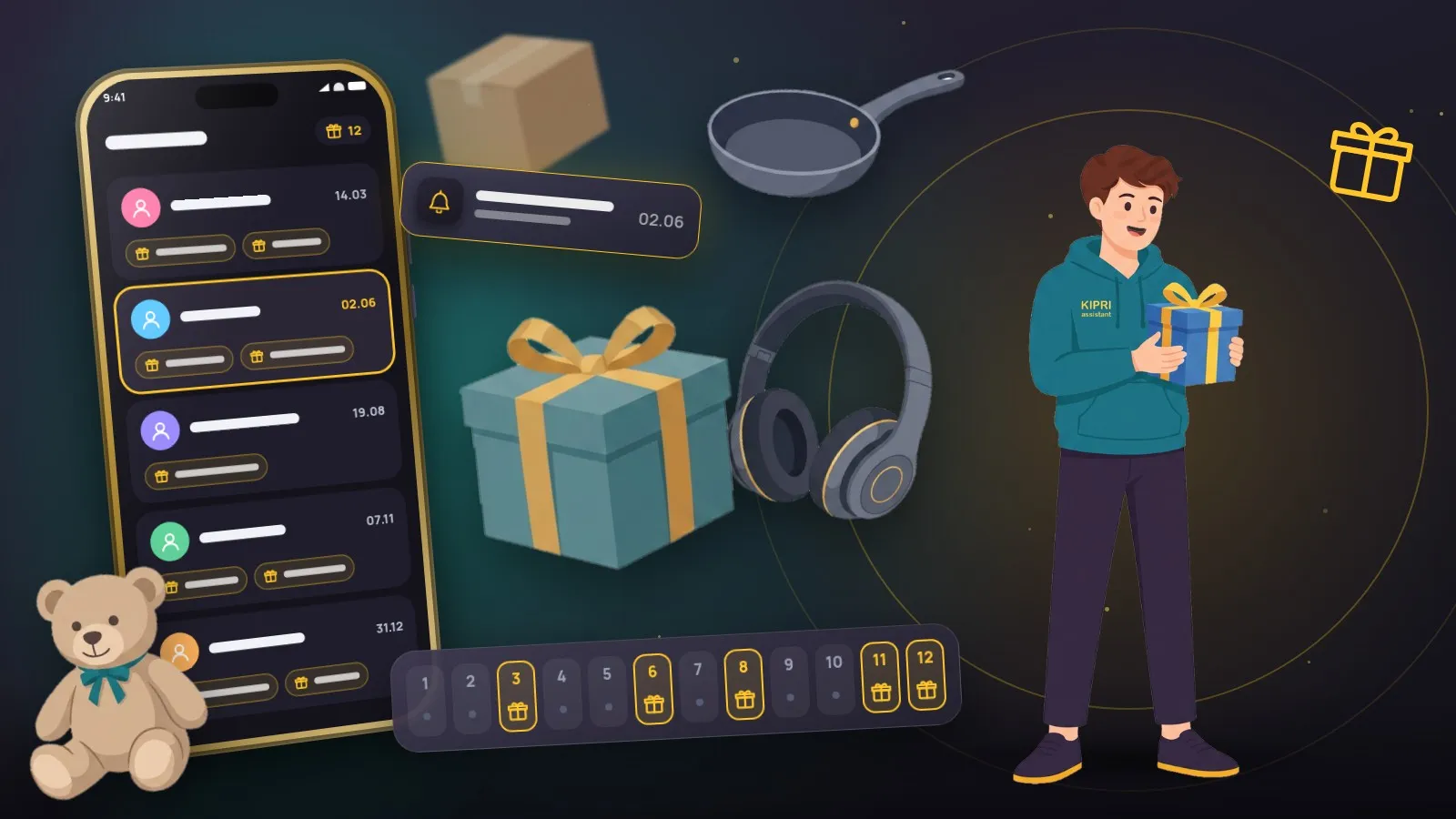
In KIPRI that note lives right next to the date itself: you can add anything you like to a person, and next year the reminder arrives with it attached.
When to be reminded
Not on the day. On the day you want a reminder to send greetings, but a gift bought then is a gift not bought.
A week ahead, to choose and order. Two or three weeks if it ships from abroad or has to be made. And one more the day before, to collect the parcel and write the card.
Three reminders on one date looks excessive right up until the first one arrives on time and the second one saves you from a parcel still sitting at the collection point.
About the gift drawer
Buying nice things in advance and keeping them in a cupboard sounds sensible and almost never works. By the time the drawer is needed, the item does not suit the person, or you have forgotten it is there, or it has quietly gone out of date.
What does work is a saved link to a specific thing. It takes no space, does not spoil, and does not push you into fitting a random object to a random person.
If nothing is written down and the party is tomorrow
Three directions that beat a voucher almost every time.
A good version of something they use daily. A cheap object held in the hand every day - an umbrella, a mug, a knife, headphones - replaced with a noticeably better one gets remembered for years.
High-quality consumables. Things they buy anyway in the cheap version: coffee, tea, cosmetics, materials for whatever they make. Hard to get wrong, and when it runs out they think of you.
An experience with a date on it. Not an abstract spa voucher but a specific ticket for a specific evening. An undated voucher expires unused eight times out of ten, and you both know it.
Then, after the party, start that note. Next year begins with reading what they told you in March rather than with a search engine.
Did this help?
Thanks, that is the best answer. If it helped, it may help someone else too.
Thanks for saying so. Tell us what was missing and we will add it: [email protected]